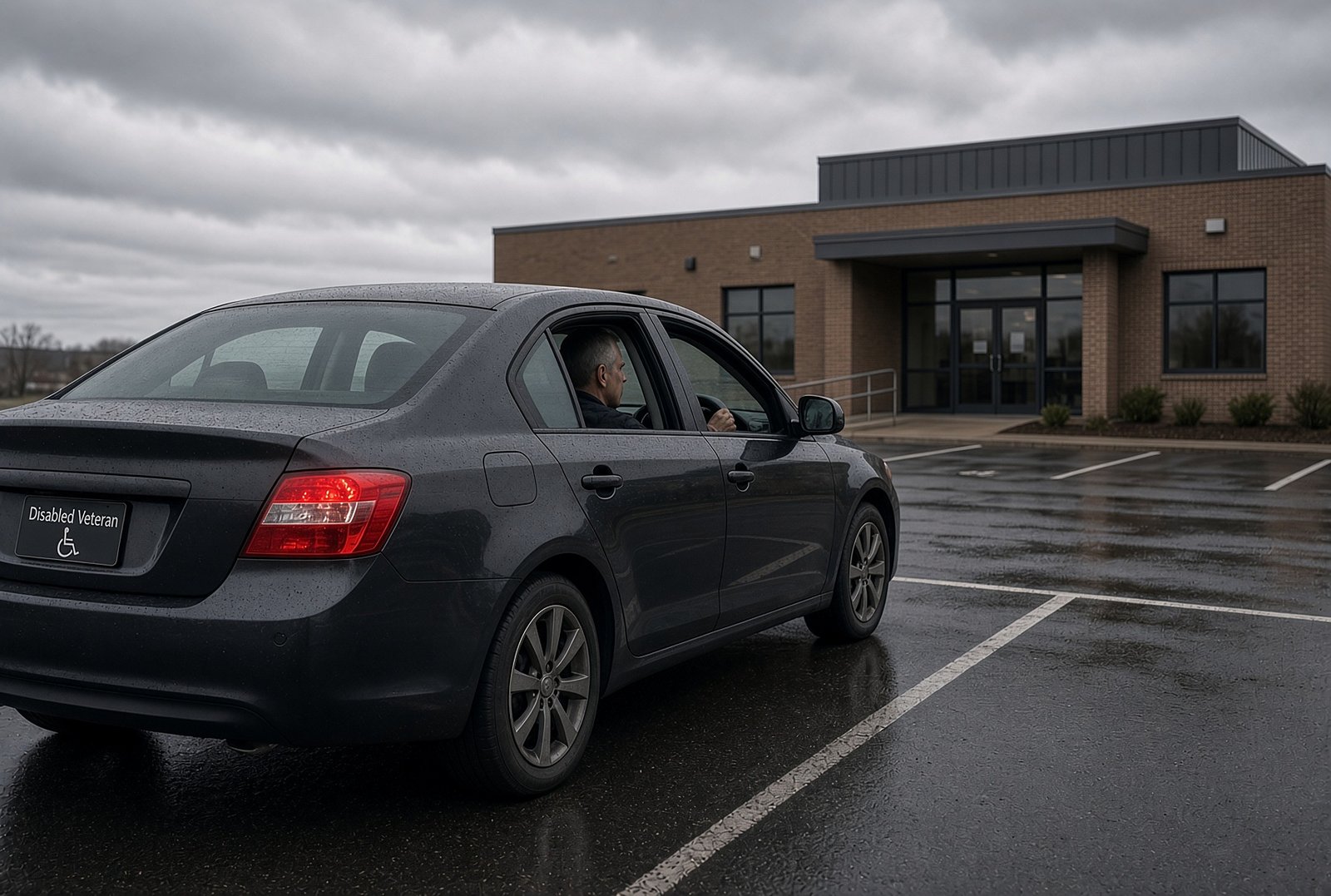
A veteran sits in a parked car outside a VA clinic with the engine running, deciding whether to go in.
The appointment may have taken months to secure. The last visit may have gone badly enough that returning required everything they had left. Or no one may know they are here at all.
If they walk through the door and complete the visit, the VA will send a survey within days. It asks whether they trust the department to fulfill this country’s commitment to veterans. Their answer becomes one data point in a quarterly number the agency publishes, cites in congressional testimony, and announces in press releases as proof of institutional health.
If they put the car in reverse and drive away, the system records nothing. No survey is sent. No data point is generated. The measurement instrument has no category for the veteran who never completes the interaction. It only counts the ones who stay.
In 2024, the Department of Veterans Affairs announced that veteran trust had reached an all-time high: 80.4 percent. A separate survey put trust in VA outpatient care at 91.8 percent.
In the most recent year for which the department has published data, 6,398 veterans died by suicide. Six in ten of them had not received VA health care in the year before their death.
They were never asked.
Those two sets of numbers describe the same institution, and they cannot both be the whole truth. The explanation is simpler than anyone hiding anything: the VA’s trust survey is sent to veterans who used VA services. The veterans who did not get the care they needed are not in the sample.
My last piece asked who delivers veterans’ mental health care, and what it costs us that only about one in four VA employees has ever worn the uniform. I closed it by saying the VA’s satisfaction data deserved its own examination. This is that examination.
Editor’s note: This is an opinion and advocacy piece written from a combat veteran’s perspective. Every factual claim is drawn from public federal records — the Department of Veterans Affairs, its Office of Inspector General, the Government Accountability Office — or from published independent research, and is linked throughout and listed in the References. Where I describe incentives or institutional behavior, I am offering reasoned interpretation, not asserting hidden facts. I invite anyone, including the VA, to engage these records on the merits.
The Argument Before the Evidence
The failures documented here are current problems with long histories, and they belong to no single administration.
The Inspector General’s annual staffing determination has been produced continuously since Congress mandated it in 2014 — roughly a dozen consecutive reports, under every Secretary who has held the office in that span. Psychology has ranked among the most severe clinical staffing shortages every year since fiscal 2019. The Government Accountability Office’s priority recommendations to the VA carry over year after year, outliving whoever happens to be running the department. And as you will see, a data reliability fix the VA promised in 2012 was found still broken in 2024.
Every administration of both parties has held this department, promised reform, and handed the same failures to the next one. Anyone who wants to use these records to score points against the other side is going to find their own side in the footnotes.
I am interested in who is permitted to check — because that is what integrity looks like in practice, and integrity is the only thing veterans have ever accepted as a basis for trust.
How the Trust Score Actually Works
The number comes from a program called Veteran Signals, or VSignals, which the VA has run since 2016. It is enormous — the VA reports sending nearly 124 million digital surveys and receiving more than 17.8 million responses, including over 6.1 million written comments. The 80.4 percent figure came from 38,293 veterans surveyed across a three-month window.
The trust score is not the only thing VSignals measures. The VA also tracks ease, effectiveness, and emotion, and publishes those alongside it. And the trust score is reported quarterly and continues to move — the figures examined here come from 2024 and 2025, and the score has kept climbing since. The argument in this article is not about any single quarter’s result. It is about what the instrument can and cannot see, in any quarter.
By the VA’s own description, surveys are sent to VA customers periodically and after interactions with VA. The VA-wide trust score is compiled by surveying randomly selected veterans with recent interactions with VA products and services. At the facility level the sampling is tighter still: patients who received care within the past 90 days, surveyed within one week of using services.
The sampling frame is veterans who used the system, drawn shortly after a completed interaction.
That means the survey structurally cannot reach the veterans who did not get the care they needed. The one who called and got nowhere. The one whose first appointment went badly enough that nothing brought them back. The one the system lost mid-treatment. Or the one who did not live long enough to be surveyed.
The VA publishes this methodology. It is on their website, and I found it in about twenty minutes. Nothing here required a leak or a records request.
The problem is what happens between the methodology and the headline.
The Question Itself
Look closely at what the VA actually asks.
“I trust VA to fulfill our country’s commitment to Veterans.”
That is not a question about care. It is a question about a promise — abstract, national, aspirational. It asks whether a veteran believes this country ought to keep faith with the people who served, and whether the VA is the institution meant to do it. Most of us believe both of those things. Many of us believe them precisely because we have watched the VA fail at them and want it fixed rather than abandoned.
A veteran can agree with that sentence completely and still have waited eight months for an appointment. Can agree with it and still have walked out of an intake that went wrong. Can agree with it and still be one of the 77.2 percent who never received a full course of evidence-based treatment. Believing in the mission and being served by the institution are two different things, and only one of them is being measured.
Then there is the scale. Veterans answer from 1 to 5, and the published figure combines everyone who selected 4 or 5. A veteran who marks 4 — agree, with reservations, the answer of someone who believes in the mission but has stories — is counted identically to a veteran who marks 5. The 80.4 percent is not 80.4 percent of veterans who are satisfied. It is the share who did not actively disagree with a statement about the nation’s obligation to its veterans.
The VA does ask about care. Alongside trust, VSignals measures ease — “It was easy to get the care or service I needed” — effectiveness, “I got the care or service I needed,” and emotion, “I felt like a valued customer.”
Note which one scores lowest. In the same quarter that trust reached 80.4 percent, ease came in at 75.9. Among veterans who successfully received care and stayed engaged enough to answer a survey about it, the hardest part was getting in.
But all four questions share the same blind spot, and it is not in the wording. Every one of them is asked after an interaction is complete. The veteran who could not get in never rates ease. The veteran who did not get the care they needed never rates effectiveness. The veteran who felt like a case number rather than a person never rates emotion.
The problem was never which question the VA asks. It is who is still there to answer.
And of the four, trust is the one that leads. It is the number in the press releases, the number in the congressional testimony, the number offered as proof the department is working. It asks whether we still believe in the promise — and our answer is reported as a verdict on their performance.
“Veteran Trust in VA” Is Not What It Sounds Like
When the VA announced the 2024 figure, the press release was titled: Veteran trust in VA has increased 25% since 2016, reaches all-time high. Not “trust among veterans who used VA services this quarter.” Not “trust among survey respondents.” Veteran trust in VA.
A reasonable person reading that headline concludes that roughly four in five American veterans trust the VA. The methodology does not support that conclusion.
An institution is responsible for the conclusion its public communication invites, not only for the accuracy of its footnotes. When the number is presented as veteran trust rather than trust among the veterans we successfully served, the framing does work the methodology cannot do. And once that number is used to demonstrate institutional health, it becomes a shield against the very criticism the excluded population represents.
Here is the structural problem stated plainly: a survey that samples only completed interactions cannot produce a failing grade. The veterans whose experience would drag the number down are, by design, not in the denominator. Every veteran the system loses makes the remaining sample slightly more satisfied.
Failure improves the score.
Institutions rarely volunteer to measure what would embarrass them. That is not a charge of bad faith — it is how organizations behave under pressure, and the VA is not unusual in it.
But it lands differently here. Three out of four people in this department never raised a hand and swore the oath we swore. That is not a judgment about their character or their commitment — many of them serve veterans faithfully every day. It is a statement about what that oath asks of a person, and how hard it is to explain to someone who has not taken it.
We were formed in a culture where integrity is not something you assert about yourself. It is something other people verify. Your word gets checked. Your work gets inspected. And when you fall short, someone beside you pays for it. That standard does not come off with the uniform, and it is the standard we apply to any institution asking for our trust — including this one, and including ourselves.
A department that reports its own trust score, verifies its own outcomes, and grades its own workforce is asking veterans to accept the one thing our training and our instincts taught us never to accept without proper accountability.
We are being asked to set aside a discipline we were not permitted to set aside downrange. For many of us, integrity is not negotiable.
The Response Rate, and Why Veterans Stop Answering
Nearly 124 million surveys sent. More than 17.8 million responses. That is a response rate in the neighborhood of 14 percent.
Low response rates are common and do not automatically invalidate a result. But they carry a known risk called non-response bias: the people who answer may differ systematically from the people who do not. And the VA’s own methodologists have said so. In its request to the Office of Management and Budget for survey clearance, the department wrote that the exclusion of portions of veterans from the survey contributes to measurement error, and that the extent to which estimates are skewed depends on the potential alignment between veteran sentiment and their likelihood to respond.
Read that carefully. The VA has stated in a federal clearance document that if unhappy veterans are less likely to respond, the published numbers are skewed.
There is also an opt-out. Participation is voluntary, and veterans may decline and remove themselves from all future invitations. And per the VA’s own Privacy Impact Assessment, how often a veteran receives a survey is determined by a combination of factors including opt-out status. The veterans who have decided the VA does not listen take themselves out of the sample, permanently, and that removal is a coded input into who gets asked next.
Nobody has to exclude anyone. The instrument self-cleans.
Now ask the harder question: why would a veteran who does not trust the VA fill out a VA survey about trust?
They would not. And their reasons are the same reasons they do not trust it — no accountability, no transparency, and a well-earned belief that nothing they say will change anything. Non-response here is not apathy. It is an accurate assessment.
The trust score requires trust to participate in it. Distrust removes itself from the sample. The VA documented the risk, applied statistical weighting, and published the headline — and weighting can adjust for who responds within a frame. It cannot repair a frame that never contained the veteran who walked away. No statistical method can substitute for asking the people you failed.
The Question Underneath
There is something else underneath that response rate, and I will put it plainly because I am one of the veterans it applies to.
Is it reasonable to assume that a veteran might hesitate to give honest, critical feedback to the same agency that determines their service-connected rating?
Consider the architecture. VSignals is designed by the VA, administered by the VA, and sent to veterans about the VA. It is not uniformly anonymous — the department’s own Privacy Impact Assessment describes contacting veterans when service recovery is warranted based on the feedback given, which necessarily means some responses are linked to the person who gave them. And the department reading that feedback is the same department that adjudicates disability compensation, schedules reexaminations, and decides what a veteran’s injuries are worth for the rest of that veteran’s life.
The VA could put this question to rest tomorrow by opening its survey administration to independent review. It has not. Until it does, a veteran weighing whether to answer honestly is left to assess that risk alone, with no assurance from anyone who does not work for the agency in question.
And that is the flaw in the whole approach. An institution cannot resolve a conflict of interest by assuring you it has none. That is not how trust is built anywhere else — not in medicine, not in auditing, not in the courts, not in any workplace that takes employee feedback seriously. Every one of those systems long ago accepted the same principle: when the party being evaluated controls the evaluation, the result is not credible, no matter how honest the intentions behind it.
The safeguard is not good faith. The safeguard is separation.
American healthcare settled this decades ago. Hospitals billing Medicare are surveyed on patient experience under a standardized national instrument. They may use an approved outside vendor, or administer it themselves — but only with federal approval, under external oversight that includes inspection of their survey procedures and site visits, with financial penalties for non-compliance. The conflict of interest is recognized, and it is supervised.
In the VA’s case, there is no approving body. There is no site visit. There is no penalty, because there is no external standard to violate. The department designs the instrument, selects the sample, administers the survey, interprets the results, and writes the press release.
The VA has asked veterans to accept its word on a question it structured itself to answer. Then it publishes the result as evidence that veterans trust it.
A survey a respondent fears cannot measure trust. It measures who felt safe enough to answer.
What the Excluded Population Looks Like
If the veterans outside that frame were a small remainder, none of this would matter much. They are not.
RAND’s foundational work on post-deployment mental health found roughly half of veterans who needed care did not seek it. Not dropped out — never came.
Among those who did come, a 2019 study in Psychiatry Research followed 265,566 Iraq and Afghanistan veterans with PTSD across 130 VA facilities over fifteen years. Only 9.1 percent completed a full course of evidence-based treatment. Fully 77.2 percent never received one. In routine VA outpatient care, published dropout rates run as high as 38.5 percent.
And then the numbers that end the argument.
In 2023, 6,398 veterans died by suicide — 44 fewer than the year before, which the VA reported as progress. But the rate per 100,000 rose for both male and female veterans: women from 13.7 to 13.9, men from 37.3 to 37.8. Age-adjusted rates rose 2.8 percent for female veterans and 3.1 percent for male veterans, while falling 0.8 percent and 2.3 percent for non-veteran adults over the same period.
Veteran suicide rates rose while civilian rates fell. The gap widened, and the headline said the number went down.
Sixty-one percent of the veterans who died had not received VA health care in the year before their death.
Then this, from the VA’s own report. Measured across the full span from 2001 to 2023, age-adjusted suicide rates rose 23.0 percent for male veterans with recent VHA use — and 71.1 percent for male veterans without it.
Twenty-two years of divergence. The population the survey cannot reach has deteriorated at roughly three times the rate of the population it measures, and the gap has been widening the entire time.
One caution, because it matters and a serious reader will catch it: raw suicide rates are actually lowest among veterans not using VHA care, which reflects that sicker veterans seek treatment. The comparison that holds is trajectory, not level — and the trajectory for the unreached population is catastrophic.
Now the finding that changes what all of this means. Over that same 2001 to 2023 span, the suicide rate among veterans in VHA care with mental health or substance use diagnoses fell 34.7 percent — from 87.0 per 100,000 to 56.9.
Hold that number next to the other one. Sixty-one percent of the veterans who died were not in this system at all.
Being inside is not a guarantee — only 9.1 percent complete a full course of treatment, and as many as 38.5 percent leave before finishing. The system fails people on the inside too, constantly.
But being inside is survivable in a way that being outside is not. Across two decades, the rate fell 34.7 percent for veterans connected to care. For the ones who were not, it rose 71.1 percent.
Not that the VA works. That proximity to it — even imperfect, even understaffed, even with an intake that loses one in three — still beats the alternative for the population dying fastest.
Which means every veteran this system fails to reach is not a customer service problem. It is a person on the wrong side of a 71 percent curve, invisible to every instrument the department uses to grade itself.
VHA enrollment has grown from 3.8 million veterans in 2001 to 6.1 million in 2023. Growth did not solve reach.
Even the Death Count Is Contested
In my last article, I cited the VA’s suicide figures at face value on purpose. Here is why they deserve the same scrutiny as everything else.
The VA does not observe veteran suicides directly. It builds its count from death records reported by county coroners and medical examiners, cross-referenced with federal data. The nation’s most-cited veteran statistic depends on thousands of county officials correctly identifying that a decedent served.
Operation Deep Dive — a multi-year study by America’s Warrior Partnership, contracted with the University of Alabama and partnered with Duke University — examined death records from eight states between 2014 and 2018 and cross-matched them against Department of Defense service data. It found that county reporting failed to identify veterans roughly 18 percent of the time.
Corrected for that gap, researchers counted approximately 24 former service members dying by suicide per day, against the VA’s 17.7 for the same period — a rate 37 percent higher than officially reported.
The study went further, examining self-injury mortality — overdoses and similar deaths often classified as accidental. Those estimates run higher still, and I present them separately because they involve a definitional expansion beyond coroner-classified suicide, not the same measure.
Two things must be said in fairness. The study’s own president was direct about where the failure sits: “It’s not the VA’s fault. The issue is the counties.” And a peer-reviewed response to Operation Deep Dive was published in Military Medicine in 2023, contesting aspects of its methodology.
But fairness runs both directions. The counties are not the ones publishing a national suicide report. The VA is. An agency that builds its most consequential public statistic on an identification process failing roughly one time in five has a responsibility that does not end at the county line.
The department has known about this gap for years. There is no federal standard for verifying military service on a death certificate, no standardized tool given to coroners and medical examiners, no national requirement that anyone checks. Those are fixable problems, and fixing them would fall to the agency whose numbers depend on them. Instead the figure is published annually, cited in congressional testimony, printed in press releases, and treated as settled.
Whatever the true number is, the VA has not built the system that would let anyone find out. That is not the counties’ failure. That is a choice about what is worth measuring accurately.
And note what happened when someone finally measured it independently. The study found the count materially low. The published rebuttal came from VA-affiliated researchers. The independent number is disputed by the institution being measured, and no neutral party has settled it.
Who checks?
This Is Not Only a Survey Problem
If the trust score were the only place the VA graded its own work without outside verification, it could be dismissed as one flawed instrument. It appears in program after program.
In June 2012, the Government Accountability Office recorded a VA commitment: the department expected to fully implement reporting through its new Homeless Operations, Management, and Evaluation System — HOMES — by July 2012, and according to the VA, the system incorporated additional data reliability controls, including fields that automatically limited responses to predefined ranges.
That was the fix. New system, better controls, trustworthy numbers.
In September 2024, the VA’s own Inspector General reviewed what HOMES was producing. It found outcome data unreliable for approximately 888 of 4,151 veterans recorded as having exited into permanent housing — one in five. It also found the system failed to accurately capture negative exits, the cases where veterans left under bad circumstances.
Twelve years. Four administrations. The system built to make the numbers trustworthy could not be trusted.
The reasons are not technical. Program liaisons were not verifying grantee-reported information. Liaisons were not following the system’s own data definitions when recording housing outcomes. Medical facilities were not validating what the liaisons entered. Three layers of verification, none operating — in a program running more than $275 million that served nearly 24,000 veterans in fiscal 2022.
There is a second finding in that report that deserves its own attention, because it describes how failure disappears.
The Inspector General found that HOMES failed to accurately capture negative exits — the cases where veterans left the program under bad circumstances. Set that against how the program is built. These are not VA beds. Grant and Per Diem housing is operated by community organizations under VA grants. The grantee reports the outcome. The liaison was not verifying it. The facility was not validating it.
So when a veteran in a grantee-run bed succeeds, that success flows upward into the Homeless Services Scorecard and becomes part of the department’s public performance reporting. When a veteran in that same bed relapses, disappears, overdoses, or dies, the record of it travels through a chain the Inspector General found unreliable one time in five — and lands in the exact category the OIG identified as least accurately captured.
The consequence is not theoretical. A veteran served outside VA walls, whose outcome is reported by someone else and verified by no one, can stop registering as a VA outcome at all. The cost of that failure lands on a city, a county, a family, a coroner. It does not land on the scorecard.
This is the same structure as the trust survey, in a different program. Success is measured where it happens. Failure happens somewhere the measurement does not reach.
This is not a back-office dataset. The VA’s homeless programs office describes HOMES as the primary data system for VA’s national homeless performance measures, including the Homeless Services Scorecard. The system the Inspector General found unreliable generates the department’s public performance reporting.
The Inspector General named the consequence directly: better controls would improve leaders’ ability to make informed decisions about what unhoused veterans need, and would allow the VA to hold grantees accountable. Read that backward. Without reliable data, the VA cannot make informed decisions and cannot hold its grantees accountable. That is the Inspector General’s conclusion, not my inference.
What it looks like on the ground is documented too. In a separate administrative investigation, the OIG found staff responsible for overseeing a transitional housing grantee in San Diego knew that through 2021 and most of 2022, drug sales by non-residents, drug use, and insufficient staffing were increasing risks to veterans housed there — and did not take timely or effective action.
Veterans lived in that risk while the oversight structure that existed on paper failed to function.
Even the Watchdog Reports Unverified Numbers
The staffing data contains the single most telling admission in this piece.
The Inspector General’s most recent annual determination found VHA facilities reporting 4,434 severe occupational staffing shortages — a 50 percent increase over the prior year, spanning 41 occupations, the highest count since facility-level surveying began in fiscal 2018. All 139 facilities reported shortages. Not most. All. Psychology was the most frequently reported severe clinical shortage, named by 57 percent of facilities.
Then, in its own methodology, the OIG states that it did not independently verify VHA’s data for accuracy or completeness.
So the homeless outcome data is self-reported by grantees and unverified. The staffing shortage data is self-reported by facilities and unverified by the inspector general publishing it. The trust score is self-administered among veterans the VA served. The suicide count depends on county officials with no standardized way to confirm military service.
Four of the most consequential datasets in veteran policy, in four different domains, resting on the same foundation — the institution reporting on itself, with the verification step missing.
At some point that stops being a series of oversights and starts being an operating model.
Finding Is Not Fixing
The Inspector General finds these problems. That function works. What does not work is what happens next.
Of the 28 most urgent fixes the Government Accountability Office identified for the VA in June 2024, the department had completed four a year later — while GAO added five more, bringing the list to 29. The watchdog can investigate. It cannot make anyone act.
That is why the reports keep accumulating and the conditions do not change. And it is the answer to why veterans stop answering surveys. A veteran who reports a problem and watches nothing happen has learned the same lesson this record teaches. Disengagement is not irrational. It is what happens when a population correctly infers that reporting produces documentation rather than change.
The Number the VA Chooses Not to Publish
My last piece argued that veteran representation in the VA’s mental health workforce is a clinical variable, not a demographic preference — that shared experience builds the trust the research says predicts whether veterans complete treatment at all.
There is a number that would settle whether the VA is meeting that standard. The VA does not publish it.
The department-wide figure is public: roughly one in four VA employees is a veteran. But the breakout for the clinical mental health occupations — how many VA psychologists, psychiatrists, and clinical social workers have served — does not appear in any public dataset.
That absence has to be read against what the profession itself requires. The National Association of Social Workers published standards in 2012 naming military and veteran cultural competence as a specific professional obligation. The Council on Social Work Education, the sole accrediting body for social work programs in this country, publishes a specialized curricular guide for military and veteran social work and requires accredited programs to graduate practitioners who can demonstrate cultural competence in practice. The field defined the standard. The VA is the largest employer of clinical social workers in the United States.
And the VA does not report how many of the clinicians it seats across from veterans hold the one form of competence those standards treat as hardest to teach.
Every other performance measure in this department gets a number. Wait times get a number. Trust gets a number, published quarterly with a press release. Staffing shortages get an annual report to Congress. The composition of the workforce delivering veteran mental health care — the thing my entire last article argued is a clinical variable — does not.
An institution that measures everything it wants measured, and does not measure this, has made a choice.
The Four-Year Hole
There is a specific window in this department’s recent history that no independent body has examined, and the data to examine it already exists.
From roughly 2021 through 2024, the VA — like much of the federal government — operated formal diversity, equity, and inclusion programs under federal directive. Those programs required agencies to collect and assess workforce demographic data. When the department ended them in January 2025, it announced halting more than $14 million in DEI spending, including roughly 60 positions and over $6 million in consulting contracts.
Here is the gap. The Government Accountability Office has already performed exactly the analysis veterans need — its 2023 report examined VA workforce outcomes by race, ethnicity, and gender, comparing pay, promotion, and career progression among employees hired into similar occupations. It is rigorous, independent, and federal.
It covers fiscal years 2000 through 2021. It ends precisely where the DEI period begins.
So I am not asking anyone to invent a new inquiry. I am asking the federal government to extend the analysis it already conducted — by race, ethnicity, and gender, exactly as GAO performed it — through fiscal 2024, and to add one variable it has never included: veteran status.
That last piece is the one that matters most to me. In no period — not the GAO window, not before, not since — has anyone cross-tabulated VA hiring, promotion, and retention outcomes by veteran status. The question most relevant to the population this department exists to serve has never been asked by anyone the department does not employ.
I am not going to tell you what such a review would find. People on both sides have announced that conclusion without the study, and I will not join them. GAO’s analysis of the years it did examine produced findings that complicate the simplest version of the story, and honest people should sit with that rather than skip past it.
What I will say is this: the data was collected. The methodology exists and has already been applied by an independent federal body. The only thing missing is the decision to extend it four years and add the one variable that describes us. Veterans are owed an answer that does not come from the institution grading itself.
What Veterans Should Know About the Front Desk
Everything above is systemic. This part is practical, and if you take one thing from this article, take this.
When a veteran expresses frustration with care — a provider who does not fit, a wait that has run too long, a referral that stalled — the response is often a question that sounds like customer service: Do you want to cancel?
Say no. Say it every time, and say it in writing.
Answered wrong, that question can convert a complaint about the quality of care into a notation that the veteran declined care. That notation does not stay in an appointment log. Gaps in treatment become part of the medical record, and in the claims system the absence of treatment records can be read as evidence that a condition improved or resolved. Under 38 CFR § 3.655, failing to report for a scheduled examination without good cause carries consequences for a veteran’s claim. The system that recorded your frustration as a refusal can later treat that refusal as a fact about your health.
So do not decline. Redirect. The language that protects you is simple, and it belongs in writing:
“I am not declining care. I am requesting a different provider, and I want my record to reflect that distinction.”
Send it through secure messaging so a dated record exists. Under VHA Directive 1003.04, patient complaints are documented in the Patient Advocate Tracking System, and that documentation is required to include the veteran’s desired resolution. State yours explicitly, in your own words, and ask that it be recorded.
If you are refused, you have a formal right most veterans have never heard of. Under VHA Directive 1041, Appeal of Veterans Health Administration Clinical Decisions, a veteran or the veteran’s representative may file a clinical appeal — a higher-level reconsideration request to override a medical decision made at the facility level. The process is documented, tracked, and time-bound:
- The appeal is filed through the facility’s patient advocate and tracked in PATS.
- If the facility-level decision does not resolve it, the veteran may appeal to the VISN, which has 30 days to complete its review, with the VISN Director responding within 45 days.
- An independent external review may be requested, and when it is, the clinical record and supporting documentation must be forwarded for outside evaluation.
- The decision is entered into your electronic health record under a progress note titled Clinical Appeal Decision, and you are to be contacted by your preferred method of communication.
Community care eligibility determinations are treated as medical determinations and are appealable through this same directive.
And here is the part worth sitting with. Directive 1041 requires facilities to ensure that patients and their representatives are aware of their right to dispute a clinical decision and the process for appealing it. Ask the veterans in your life how many have ever been told that right exists.
Know the law behind the referral, too. Under the MISSION Act, community care eligibility is a right when the criteria are met, not a favor granted at a scheduler’s discretion. Reporting has documented schedulers under pressure from facility administrators to keep veterans in-house rather than refer them out. Congress saw the pattern clearly enough to legislate: the Elizabeth Dole Act, signed in December 2024, prohibits VA administrators from overriding a VA physician’s referral for outside care.
If a notation already sits in your record saying you declined care when you did not, raise it with the patient advocate, state the correction you want in writing, and appeal if it is not fixed.
None of this is confrontation. It is documentation — the same tool the institution uses. Use it.
The Ask
The VA cannot fix a verification problem with more self-verification. That points to specific remedies.
An independent, third-party national survey of veterans — designed, administered, and published outside the VA’s control. One that reaches the veterans who walked out the door, not only the ones who came back for another appointment. Ask the veterans who never enrolled why they never came. Ask the ones who left mid-treatment what happened. Ask the families of the six in ten what the last year looked like. The sample cannot be drawn from VA enrollment rolls, because the veterans who matter most to this question were never on them — and it cannot be administered by the department being evaluated, for the same reason no hospital grades its own patient experience without outside supervision.
Release the 6.1 million comments. VSignals has collected over 6.1 million free-text responses — veterans describing their experience in their own words. It is very likely the largest qualitative dataset on veteran experience ever assembled, and none of it is public. De-identified and released, it would tell researchers, Congress, and veterans more about this system in a month than a decade of percentage scores.
Public reporting of clinical staffing by veteran status. Not a study — a standing requirement that the VA publish, by occupation, how many of its psychologists, psychiatrists, and clinical social workers are veterans, reported quarterly like the trust score and subject to the same visibility.
Extend GAO’s workforce analysis through fiscal 2024, by race, ethnicity, and gender as originally conducted, and add veteran status. The methodology exists. The data was collected. Close the four-year hole.
Independent verification of the data the VA already publishes, including a federal standard and tooling that lets coroners and medical examiners confirm military service, so the death count stops depending on guesswork. It is the VA’s responsibility to ensure the numbers it reports are accurate and properly vetted. No one else can be blamed for the condition of a report the department signs its own name to.
None of this requires a new agency. It requires deciding that an institution serving nine million veterans should not be the sole author of its own report card.
What I Am Not Arguing
I want to be precise about what this is not.
This is not a claim that every VA clinician is failing. My own primary care physician has served me well, and the surgeons who operated on me were skilled. But I know better than to generalize from that. Wait times in this system are long enough to change outcomes, and for a veteran waiting on a cardiac workup or an oncology referral, delay is not an inconvenience. It is the diagnosis arriving too late to matter.
So this is not a verdict on the people inside that building. It is a verdict on a system that cannot verify its own numbers, cannot say who staffs its mental health workforce, and measures its own trust among the veterans it successfully served. Good people work there. That has never been the question.
The question is whether anyone outside is permitted to check.
What Comes Next
Institutions wait people out. It is a strategy, and it works often enough to be worth trying — file the complaint, publish the piece, and see whether the person behind it loses interest, runs out of money, or simply moves on.
So let me answer the question before anyone asks it. My mission does not end with this article. It moves to its new arena.
The record assembled here is public and permanent. The Inspector General’s findings do not expire. GAO’s open recommendations do not close themselves. The four-year window nobody has examined stays unexamined until someone examines it. The number the VA declines to publish stays unpublished until publishing it is required. Silence resolves none of it — silence leaves it standing, with the questions still attached.
I will take this as far as it needs to go, for as long as it takes, through every legitimate channel available to me. I am not passing through this field. I begin a Master of Social Work program this month, I am completing my certification as a peer support specialist, and I intend to spend the rest of my working life in and around veteran care. Whatever the pace of institutional change turns out to be, I will still be here when it arrives.
We were trained to hold ground nobody was coming to relieve. That habit does not switch off when the uniform comes off.
To the VA, plainly: I would rather write about your recovery than your record. That remains available. Every fix in this article uses tools you already have, and the first one costs nothing but permission — let someone else check the work. The safeguard was never good faith. The safeguard is separation, and an institution confident in its numbers has nothing to fear from an outside set of eyes.
And to the six in ten who never made it into the sample, and to every veteran who stopped answering because answering never changed anything: you were not counted, but you are not forgotten. Somebody is asking about you now, and I got your six!
De Oppresso Liber.
This article is part of an ongoing series on veteran care — following pieces on veteran life insurance, peer support, an open letter on VA mental health intake, and Veterans at the Therapy Table.
References
- U.S. Department of Veterans Affairs. Veteran Trust in VA (VSignals methodology; sampling of randomly selected veterans with recent interactions; 5-point Likert scale reported as share answering 4-Agree or 5-Strongly agree; all four measures — Trust, Ease, Effectiveness, Emotion — with exact question wording; VSignals reporting to OMB Circular A-11). va.gov
- U.S. Department of Veterans Affairs. Veteran trust in VA has increased 25% since 2016, reaches all-time high, May 28, 2024 (80.4% trust; 38,293 veterans surveyed January 1–March 31; ease 75.9%, effectiveness 80.5%, emotional resonance 78.4%; 91.8% outpatient trust attributed to a separate survey). va.gov
- U.S. Department of Veterans Affairs. Facility-level trust press releases, 2024 (Boston 94.4%; Eastern Oklahoma 92.9%; Western Colorado 92.3%; 90-day care window; one-week survey timing). va.gov
- U.S. Department of Veterans Affairs, Veterans Experience Office. VSignals Privacy Impact Assessment (opt-out as a factor in survey frequency; service recovery contact based on feedback given). va.gov
- U.S. Office of Management and Budget / Department of Veterans Affairs. Survey clearance submission (measurement error from excluded veterans; alignment between veteran sentiment and likelihood to respond). reginfo.gov
- Centers for Medicare & Medicaid Services. HCAHPS Facts (standardized instrument; CMS-approved vendors or CMS-approved self-administration; oversight including site visits; payment consequences for non-compliance). cms.gov
- Military.com. VA Says Veteran Trust Hit an All-Time High. Here’s What the Survey Measures (~124 million surveys sent; 17.8 million responses; 6.1 million free-text comments; sampling limitations). military.com
- U.S. Department of Veterans Affairs. 2025 National Veteran Suicide Prevention Annual Report, released February 2026, covering 2001–2023 (6,398 veteran suicide deaths in 2023, 44 fewer than 2022; 61.0% not receiving VHA care in the prior year; unadjusted rates rising 13.7→13.9 for women and 37.3→37.8 for men; age-adjusted rates 2001–2023 rising 23.0% for male veterans with recent VHA use versus 71.1% without; suicide rate among veterans in VHA care with mental health or substance use diagnoses falling 34.7% from 87.0 to 56.9 per 100,000 across 2001–2023; VHA enrollment growth from 3.8 million in 2001). Part 1 · Part 2 · news.va.gov
- America’s Warrior Partnership, University of Alabama, and Duke University. Operation Deep Dive (eight states, 2014–2018; ~18% veteran identification failure; ~24/day vs VA’s 17.7/day). americaswarriorpartnership.org
- Raines, A.M., Houtsma, C., Boffa, J.W., & Constans, J.I. (2023). “A Response to Operation Deep Dive’s Interim Report on Veteran Suicide Rates.” Military Medicine. doi.org
- U.S. Government Accountability Office. Veteran Homelessness: VA and HUD Are Working to Improve Data on Supportive Housing Program. GAO-12-726, June 2012. gao.gov
- VA Office of Inspector General. Additional Controls Are Needed to Improve the Reliability of Grant and Per Diem Program Data. September 2024. vaoig.gov
- U.S. Department of Veterans Affairs, VA Homeless Programs. What is HOMES? department.va.gov
- VA Office of Inspector General. Ensuring Grantee Compliance with Veteran Care and Safety Requirements in Transitional Housing: Lessons Learned from San Diego. March 2025. vaoig.gov
- VA Office of Inspector General. OIG Determination of VHA Occupational Staffing Shortages (annual series; severe shortage counts; psychology ranking; methodology note on non-verification of VHA data). vaoig.gov
- U.S. Government Accountability Office. Priority Open Recommendations: Department of Veterans Affairs. gao.gov
- U.S. Government Accountability Office. VA Equal Employment Opportunity: Increased Attention Needed to Improve Program Effectiveness. GAO-23-105429 (workforce outcomes by race, ethnicity, and gender, FY2000–FY2021). gao.gov
- U.S. Department of Veterans Affairs. VA ends DEI, stops millions in spending on DEI. January 2025. news.va.gov
- Maguen, S., et al. (2019). “Factors associated with completing evidence-based psychotherapy for PTSD among veterans in a national healthcare system.” Psychiatry Research, 274, 112–128. PubMed
- Kehle-Forbes, S.M., et al. (2016). “Treatment initiation and dropout from prolonged exposure and cognitive processing therapy in a VA outpatient clinic.” Psychological Trauma, 8(1), 107–114. doi.org
- RAND Corporation. Invisible Wounds of War (MG-720). rand.org
- National Association of Social Workers. Standards for Social Work Practice with Service Members, Veterans, and Their Families (2012). socialworkers.org
- Council on Social Work Education. Specialized Practice Curricular Guide for Military and Veteran Social Work; 2022 Educational Policy and Accreditation Standards. cswe.org
- U.S. Department of Veterans Affairs. VHA Directive 1041, Appeal of Veterans Health Administration Clinical Decisions, September 28, 2020. va.gov
- U.S. Department of Veterans Affairs. VHA Directive 1003.04, VHA Patient Advocacy. va.gov
- 38 CFR § 3.655 — Failure to report for VA examination. ecfr.gov